
RUO Disclaimer: All QRM products are strictly for in vitro laboratory and research use only by qualified researchers in appropriate facilities. Nothing here implies, suggests, or recommends any diagnostic, therapeutic, or clinical application or use in humans or animals.
- SSL Secured
- Secure Checkout
- Guaranteed Delivery
- Third-Party Tested
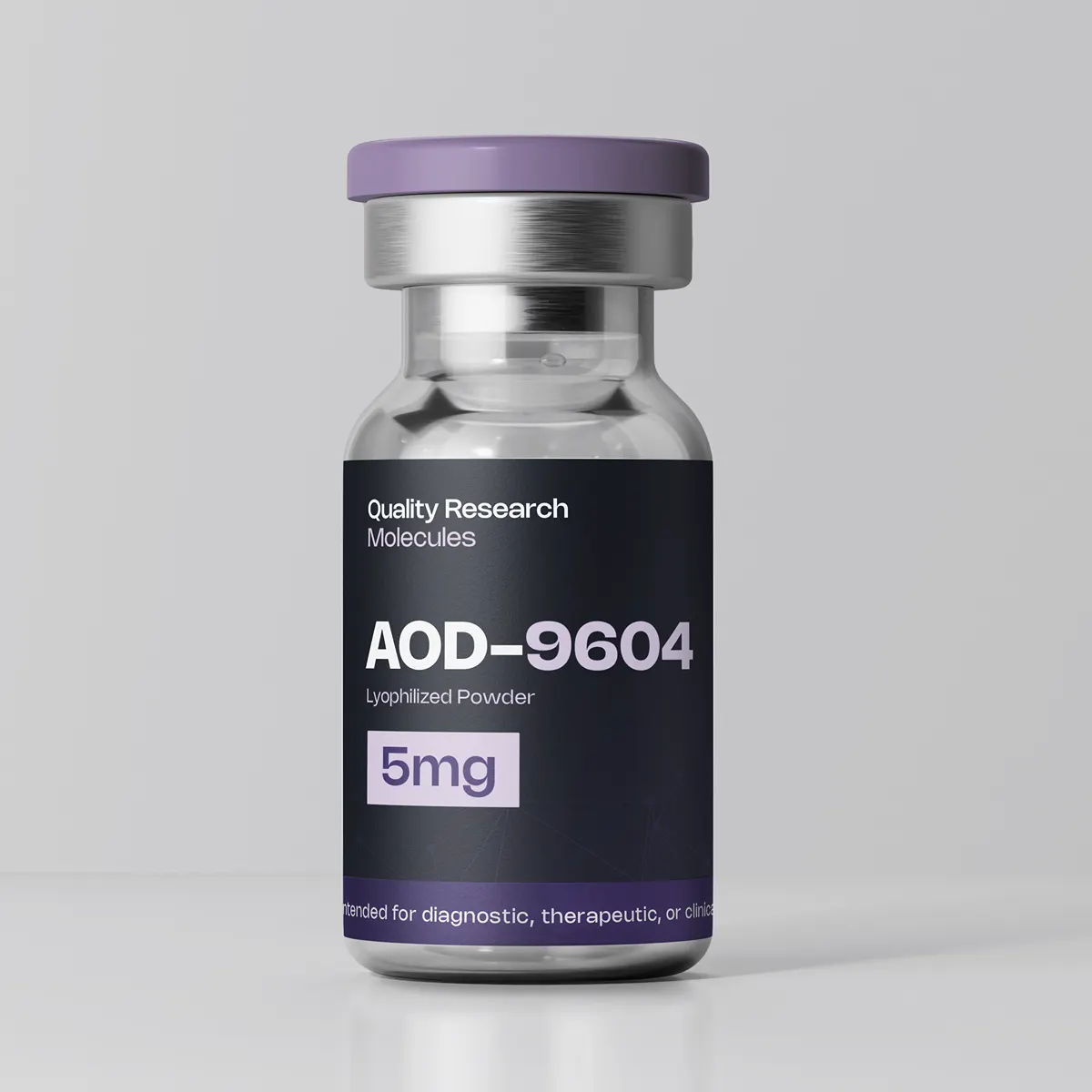
AOD-9604
A stabilized fragment of human growth hormone studied specifically for its role in fat metabolism and lipid regulation research. Isolated from the broader HGH sequence to allow targeted metabolic pathway studies.
$40.00
- +99% Purity
- Third-Party Tested
- COA Available
- SSL Secured
- Secure Checkout
- Guaranteed Delivery
- Third-Party Tested
A stabilized fragment of human growth hormone studied specifically for its role in fat metabolism and lipid regulation research. Isolated from the broader HGH sequence to allow targeted metabolic pathway studies.
About AOD-9604
AOD-9604 was developed from research into the distinct functional regions of the growth hormone molecule. Full-length growth hormone produces a broad range of biological signaling effects, some of which, including its influence on insulin sensitivity and cell proliferation signaling, can complicate research aimed at studying its metabolic and fat-regulating properties specifically. Researchers identified that the C-terminal fragment of growth hormone retained the molecule’s fat-metabolizing signaling activity while appearing to lack the receptor-binding interactions responsible for its growth-promoting and insulin-related signaling effects. AOD-9604 was synthesized as a stable, defined version of this fragment for controlled laboratory research settings.
The compound’s primary research focus is lipolysis, the process by which fat cells break down stored fat and release it for use as energy signaling. Growth hormone is known to stimulate this process at the receptor level, and AOD-9604 has been studied for its ability to replicate this specific signaling effect independently of the broader hormonal activity associated with full-length growth hormone. Researchers have investigated whether this selective activity makes AOD-9604 a useful tool for studying fat metabolism signaling in isolation, without the confounding pathway effects that accompany full growth hormone administration in research models.
Beyond fat metabolism, AOD-9604 has attracted growing research interest for its potential effects on cartilage and joint tissue signaling. Preclinical studies have investigated its potential to stimulate cartilage repair signaling and protect joint tissue from degenerative pathway activity, an area of research that emerged independently of its original metabolic focus and has since developed its own body of preclinical literature. This dual research profile, spanning both metabolic signaling biology and musculoskeletal repair pathway activity, makes AOD-9604 a compound of broad interest across several research fields.

Mechanism of Action
- Lipolysis Stimulation: AOD-9604 has been studied for its ability to stimulate lipolysis, the breakdown of fat stored in adipose tissue, through a mechanism researchers believe is independent of the growth hormone receptor that mediates full-length hGH’s broader signaling effects. Studies have examined whether this selective activity allows AOD-9604 to promote fat mobilization signaling without triggering the insulin-related and growth-promoting pathway activity associated with the complete hormone in controlled research settings.
- Lipogenesis Inhibition: Research has investigated AOD-9604’s potential to inhibit lipogenesis, the process by which excess nutrients are converted into stored fat at the cellular level. Studies have examined whether AOD-9604 reduces the rate of new fat accumulation in research models, an effect studied for its potential to complement its pro-lipolytic signaling activity in body composition research contexts.
- Beta-3 Adrenergic Receptor Activity: AOD-9604 has been studied for its effects on beta-3 adrenergic receptors, which play a role in regulating fat metabolism signaling in adipose tissue research models. Research has examined whether AOD-9604’s interaction with this pathway contributes to its observed fat-mobilizing signaling effects in preclinical research settings.
- Cartilage and Chondrocyte Signaling: Studies have investigated AOD-9604’s potential effects on cartilage tissue signaling, with research examining its ability to stimulate chondrocyte activity, the cells responsible for producing and maintaining cartilage matrix in joint tissue research models. Investigators have studied whether AOD-9604 promotes cartilage repair and regeneration signaling in joint tissue research models relevant to osteoarthritis pathway research.
- Growth Hormone Fragment Activity Profile: Research has examined AOD-9604’s activity profile relative to full-length growth hormone, with investigators studying the specific regions of the molecule responsible for its distinct signaling effects. This structural research has helped clarify which biological signaling activities are attributable to the C-terminal fragment specifically and how they differ from those of the complete hGH molecule in controlled research settings.

Research Highlights
AOD-9604's most distinctive research characteristic is its studied ability to engage fat-mobilizing signaling pathways without activating the broader receptor interactions associated with full-length growth hormone. Research has examined whether this selectivity makes it a practical tool for studying fat metabolism signaling in isolation across preclinical research models.
Studies have examined AOD-9604's effects on body composition signaling markers, with research investigating its potential to influence fat mass pathway activity without the insulin sensitivity changes associated with full-length growth hormone. This selectivity profile has positioned it as a compound of particular interest in metabolic dysregulation research contexts.
A growing body of preclinical research has examined AOD-9604's potential effects on cartilage repair signaling and chondrocyte activity in joint tissue research models. Studies have investigated its relevance to joint degeneration pathway activity, establishing a secondary research profile that has developed independently of the compound's original metabolic signaling focus.
A notable aspect of AOD 9604 research involves its studied signaling profile relative to full-length growth hormone, with studies examining whether it activates glucose metabolism and insulin sensitivity pathways in the same manner as the complete molecule. Investigators have studied this distinction as a key feature of AOD-9604's research utility in metabolic signaling contexts.
Product Specifications
- Molecular Formula
- C₇₈H₁₂₃N₂₃O₂₃S₂
- Molecular Weight
- 1,815.07 g/mol
- CAS #
- 221231-10-3
- Sequence
- Leu-Arg-Ile-Val-Gln-Cys-Arg-Ser-Val-Glu-Gly-Ser-Cys-Gly-Phe-NH₂
- Purity
- ≥99% (HPLC verified)
- Form
- Lyophilized powder
- Appearance
- White to off-white powder
- Solubility
- Universal Solvent
- Storage
- -20°C (lyophilized), 2-8°C (after preparation)
Reference
- Heffernan, M., Summers, R. J., Thorburn, A., et al. (2001). The effects of human GH and its lipolytic fragment (AOD9604) on lipid metabolism following chronic treatment in obese mice and beta(3)-AR knockout mice. Endocrinology, 142(12), 5182–5189.
- Stier, H., Vos, E., & Kenley, D. (2013). Safety and tolerability of the hexadecapeptide AOD9604 in humans. Journal of Endocrinology and Metabolism, 3(1–2), 7–15.
- Ryan, A. S., Nicklas, B. J., & Berman, D. M. (2003). Adiponectin levels do not change with moderate dietary induced weight loss and exercise in obese postmenopausal women. International Journal of Obesity, 27(9), 1066–1071
Related Products
GLP2 (TZ)
Lyophilized Powder
$90.00 – $200.00Price range: $90.00 through $200.00
- Third Party Tested
- ≥99% Purity