
RUO Disclaimer: All QRM products are strictly for in vitro laboratory and research use only by qualified researchers in appropriate facilities. Nothing here implies, suggests, or recommends any diagnostic, therapeutic, or clinical application or use in humans or animals.
- SSL Secured
- Secure Checkout
- Guaranteed Delivery
- Third-Party Tested
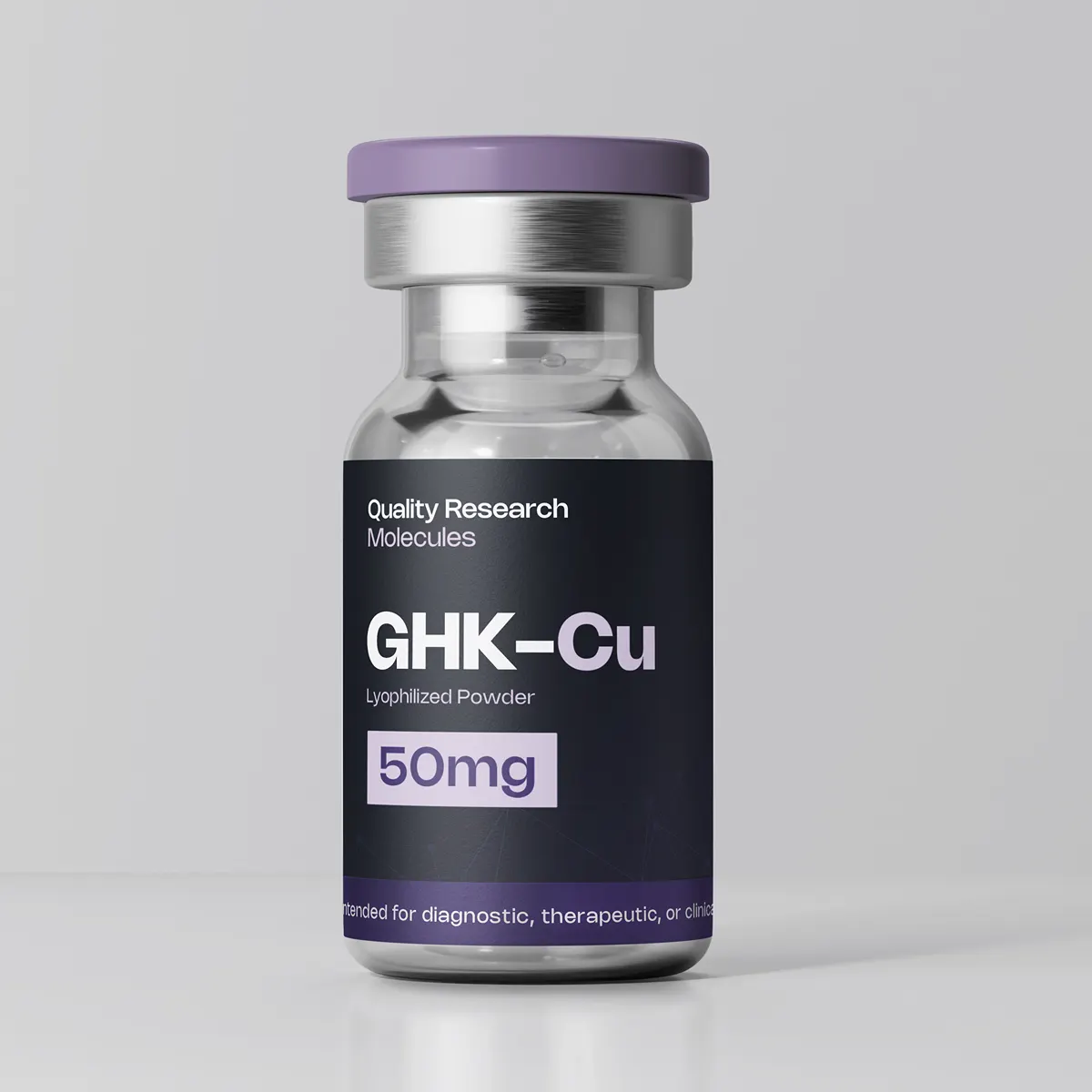
GHK-Cu
A copper-binding tripeptide found naturally in human plasma and studied extensively in skin biology, wound healing models, and gene expression research. One of the fastest growing compounds in the peptide research space.
$40.00
- +99% Purity
- Third-Party Tested
- COA Available
- SSL Secured
- Secure Checkout
- Guaranteed Delivery
- Third-Party Tested
A copper-binding tripeptide found naturally in human plasma and studied extensively in skin biology, wound healing models, and gene expression research. One of the fastest growing compounds in the peptide research space.
About GHK-Cu
GHK-Cu, glycine-histidine-lysine complexed with a copper ion, was first identified in plasma research models in the early 1970s by researcher Loren Pickart, who observed that older plasma lost the ability to stimulate tissue repair signaling that younger plasma retained. That difference was traced to GHK-Cu, launching decades of research into how this small, naturally occurring molecule influences repair and maintenance signaling pathways at the cellular level.
What distinguishes GHK-Cu in the research landscape is the breadth of its studied effects despite its small size. As a tripeptide, it is among the simplest molecules studied for regenerative signaling activity, yet research has documented its influence on collagen synthesis, wound healing pathway activity, hair follicle cycling, antioxidant defense signaling, and gene expression patterns associated with aging processes. Studies have identified GHK-Cu as a potential regulator of a large number of genes, with particular concentration in pathways related to tissue repair and anti-inflammatory signaling activity in controlled research settings.
The copper component of GHK-Cu is central to the molecule’s studied activity rather than incidental to it. Copper is an essential trace mineral investigated for its involvement in collagen cross-linking, antioxidant enzyme function, and the activity of enzymes responsible for building and maintaining connective tissue signaling pathways. GHK-Cu has been studied as an efficient carrier that delivers copper to tissue sites where these processes are active in vitro, potentially amplifying the effects of the peptide beyond what the amino acid sequence alone would produce in laboratory research models.

Mechanism of Action
- Collagen and Elastin Synthesis Signaling: GHK-Cu has been studied for its ability to stimulate the production of collagen I, collagen III, and elastin, the proteins that form the structural foundation of dermal tissue research models. Research has examined whether increasing the production of these proteins produces measurable changes in tissue density and resilience markers in aged tissue research settings.
- Extracellular Matrix Remodeling: Studies have investigated GHK-Cu’s role in regulating the enzymes responsible for breaking down old or damaged collagen at the cellular level. Research has examined whether GHK-Cu helps maintain the signaling balance between tissue breakdown and rebuilding in controlled research environments, a process studied as essential to organized tissue turnover pathway activity.
- Angiogenic Signaling Activity: GHK-Cu has been researched for its ability to stimulate new blood vessel formation signaling in tissue research models, a process studied for its relevance to nutrient and oxygen delivery to areas undergoing repair pathway activity. Vascular signaling support has been examined as a contributing factor to wound healing and tissue maintenance in preclinical research settings.
- Antioxidant Enzyme Activation: The copper delivered by GHK-Cu has been studied for its role in activating antioxidant enzymes, proteins investigated for their capacity to neutralize the damaging effects of oxidative stress at the cellular level. Research has examined whether GHK-Cu’s copper-delivery function contributes meaningfully to its observed cytoprotective signaling effects in UV-related tissue damage research models.
- Gene Expression Modulation: GHK-Cu has been investigated for its influence on gene expression at the molecular level, specifically its potential to activate genes associated with tissue repair signaling and modulate genes associated with inflammatory and aging pathway activity. Researchers have studied this gene-regulatory activity as a potential explanation for the unusually broad signaling profile observed across GHK-Cu research contexts in vitro.

Research Highlights
GHK-Cu is one of the most studied peptides in dermatological research, with studies examining its capacity to stimulate fibroblast proliferation and upregulate collagen synthesis signaling genes in laboratory research models. Research has examined changes in tissue density and structural protein organization markers in treated research models, with GHK-Cu's copper-chelating properties also studied for their role in supporting lysyl oxidase pathway activity relevant to collagen cross-linking.
GHK-Cu has been studied extensively in wound healing research models, with investigations examining its effects on wound closure signaling, new tissue organization, and scar tissue remodeling pathway activity. Research has reported changes in wound contraction signaling and re-epithelialization markers, with studies also examining its potential to influence the formation of raised, disorganized scar tissue in treated research models.
GHK-Cu has been studied in follicular miniaturization research models, with studies examining its effects on follicular keratinocyte activity and its potential to influence follicle cycling between resting and active growth phases at the cellular level. Some studies have also investigated its effects on follicle size markers, with researchers examining follicular re-population signaling in treated research models.
One of the most distinctive aspects of GHK-Cu research is its studied influence on gene expression at the molecular level. Research has identified GHK-Cu as a potential modulator of a large number of genes, with particular activity in pathways associated with tissue repair signaling, inflammatory regulation, and cellular maintenance. Investigators have studied this regulatory profile as a potential explanation for the compound's unusually broad signaling activity across dermal, follicular, and wound healing research contexts.
Product Specifications
- Molecular Formula
- C₁₄H₂₃N₆O₄Cu
- Molecular Weight
- 403.91 g/mol
- CAS #
- 89030-95-5
- Sequence
- Gly-His-Lys (copper complex)
- Purity
- ≥99% (HPLC verified)
- Form
- Lyophilized powder
- Appearance
- Blue powder
- Solubility
- Universal Solvent
- Storage
- -20°C (lyophilized), 2-8°C (after preparation)
Reference
- Pickart, L., Vasquez-Soltero, J. M., & Margolina, A. (2015). GHK peptide as a natural modulator of multiple cellular pathways in skin regeneration. BioMed Research International, 2015, 648108.
- Pickart, L., & Margolina, A. (2018). Regenerative and protective actions of the GHK-Cu peptide in the light of the new gene data. International Journal of Molecular Sciences, 19(7), 1987.
- Gorouhi, F., & Maibach, H. I. (2009). Role of topical peptides in preventing or treating aged skin. International Journal of Cosmetic Science, 31(5), 327–345.