
RUO Disclaimer: All QRM products are strictly for in vitro laboratory and research use only by qualified researchers in appropriate facilities. Nothing here implies, suggests, or recommends any diagnostic, therapeutic, or clinical application or use in humans or animals.

- SSL Secured
- Secure Checkout
- Guaranteed Delivery
- Third-Party Tested
Ipamorelin
The first selective growth hormone secretagogue studied in research models, investigated for its precise receptor binding without the off-target hormonal effects associated with earlier compounds. The precision instrument of GH pathway research.
$50.00
- +99% Purity
- Third-Party Tested
- COA Available
- SSL Secured
- Secure Checkout
- Guaranteed Delivery
- Third-Party Tested
The first selective growth hormone secretagogue studied in research models, investigated for its precise receptor binding without the off-target hormonal effects associated with earlier compounds. The precision instrument of GH pathway research.
About Ipamorelin
Ipamorelin was developed in the 1990s as part of a broader effort to identify growth hormone secretagogues with more targeted pathway activity than earlier compounds in the same class. Growth hormone secretagogues work by mimicking ghrelin, a naturally occurring hormone that signals pituitary receptors to release growth hormone. Early compounds in this class were effective at stimulating growth hormone release but also triggered increases in cortisol and prolactin, hormones associated with stress-related biological effects that complicated their research profiles. Ipamorelin was identified as a compound that could stimulate growth hormone release with significantly less effect on these other hormones, giving it a cleaner and more selective research profile in controlled research settings.
Growth hormone plays a central role in a wide range of biological signaling processes, including the regulation of body composition markers, bone density, tissue repair pathway activity, and metabolic rate. Its levels decline in research models over time, a pattern that has been associated in research with changes in lean mass, fat distribution, recovery signaling capacity, and overall tissue maintenance at the cellular level. Researchers have studied Ipamorelin as a tool for investigating what occurs when growth hormone secretion is selectively restored or augmented in growth hormone-deficient research models.
Ipamorelin is frequently studied in combination with growth hormone-releasing hormone analogues such as CJC-1295, which work through a complementary but distinct mechanism. While Ipamorelin mimics ghrelin to stimulate pituitary receptor activity, CJC-1295 acts on a separate receptor to amplify the growth hormone-releasing signal. Research has examined whether combining these two mechanisms produces a more robust and physiologically consistent growth hormone response than either compound alone in structured research environments.

Mechanism of Action
- Ipamorelin was developed in the 1990s as part of a broader effort to identify growth hormone secretagogues with more targeted pathway activity than earlier compounds in the same class. Growth hormone secretagogues work by mimicking ghrelin, a naturally occurring hormone that signals pituitary receptors to release growth hormone. Early compounds in this class were effective at stimulating growth hormone release but also triggered increases in cortisol and prolactin, hormones associated with stress-related biological effects that complicated their research profiles. Ipamorelin was identified as a compound that could stimulate growth hormone release with significantly less effect on these other hormones, giving it a cleaner and more selective research profile in controlled research settings.
- Growth hormone plays a central role in a wide range of biological signaling processes, including the regulation of body composition markers, bone density, tissue repair pathway activity, and metabolic rate. Its levels decline in research models over time, a pattern that has been associated in research with changes in lean mass, fat distribution, recovery signaling capacity, and overall tissue maintenance at the cellular level. Researchers have studied Ipamorelin as a tool for investigating what occurs when growth hormone secretion is selectively restored or augmented in growth hormone-deficient research models.
- Ipamorelin is frequently studied in combination with growth hormone-releasing hormone analogues such as CJC-1295, which work through a complementary but distinct mechanism. While Ipamorelin mimics ghrelin to stimulate pituitary receptor activity, CJC-1295 acts on a separate receptor to amplify the growth hormone-releasing signal. Research has examined whether combining these two mechanisms produces a more robust and physiologically consistent growth hormone response than either compound alone in structured research environments.

Research Highlights
Ipamorelin's defining research characteristic is its selectivity profile, with studies examining its growth hormone-releasing activity alongside its effects on cortisol and prolactin signaling in controlled research settings. Research has consistently reported that Ipamorelin produces measurable growth hormone stimulation with minimal effect on these other hormonal pathways, making it a preferred compound for investigators studying growth hormone axis activity in relative isolation from the confounding variables introduced by broader secretagogues.
Studies have investigated Ipamorelin's effects on body composition markers in preclinical research models, examining its potential to support lean mass retention and influence fat accumulation through growth hormone-mediated metabolic signaling pathways. Research has examined these effects in growth hormone-deficient research models where the natural decline in growth hormone pathway activity is associated with unfavorable shifts in body composition markers at the cellular level.
Ipamorelin has been studied in the context of bone density and connective tissue signaling maintenance in laboratory research models. Research has examined its effects on markers of bone formation and resorption pathway activity, with investigators studying whether growth hormone stimulation via Ipamorelin produces measurable changes in skeletal signaling markers in controlled research settings.
A significant portion of Ipamorelin research has examined its use alongside CJC-1295, a growth hormone-releasing hormone analogue that acts through a complementary receptor mechanism. Studies have investigated whether combining the two compounds produces a stronger and more physiologically consistent growth hormone response than either compound generates independently, establishing this pairing as one of the more studied combinations in growth hormone secretagogue research.
Product Specifications
- Molecular Formula
- C₃₈H₄₉N₉O₅
- Molecular Weight
- 711.85 g/mol
- CAS #
- 170851-70-4
- Sequence
- Aib-His-D-2-Nal-D-Phe-Lys-NH₂
- Purity
- ≥99% (HPLC verified)
- Form
- Lyophilized powder
- Appearance
- White to off-white powder
- Solubility
- Universal Solvent
- Storage
- -20°C (lyophilized), 2-8°C (after preparation)
Reference
- Raun, K., Hansen, B. S., Johansen, N. L., et al. (1998). Ipamorelin, the first selective growth hormone secretagogue. European Journal of Endocrinology, 139(5), 552–561.
- Svensson, J., Lall, S., Dickson, S. L., et al. (2000). The GH secretagogues ipamorelin and GH-releasing peptide-6 increase bone mineral content in adult female rats. Journal of Endocrinology, 165(3), 569–577.
- Johansen, P. B., Segev, Y., Landau, D., Phillip, M., & Moeller, N. (2005). Growth hormone (GH) hypersecretion and GH receptor resistance in streptozotocin diabetic mice in response to a GH secretagogue. Experimental Diabesity Research, 4(2), 73–81.
Related Products

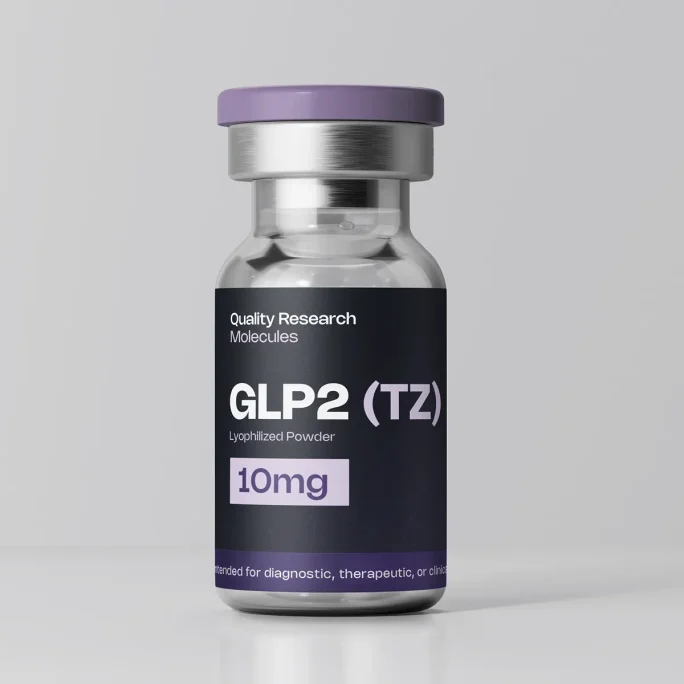
GLP2 (TZ)
Lyophilized Powder
$90.00 – $200.00Price range: $90.00 through $200.00
- Third Party Tested
- ≥99% Purity