
RUO Disclaimer: All QRM products are strictly for in vitro laboratory and research use only by qualified researchers in appropriate facilities. Nothing here implies, suggests, or recommends any diagnostic, therapeutic, or clinical application or use in humans or animals.

- SSL Secured
- Secure Checkout
- Guaranteed Delivery
- Third-Party Tested
GLP3 (RT)
The next frontier in incretin research. A triple-receptor agonist studied for its simultaneous engagement of GLP-1, GIP, and glucagon pathways, representing one of the most complex metabolic signaling compounds currently under investigation.
$100.00 – $175.00Price range: $100.00 through $175.00
- +99% Purity
- Third-Party Tested
- COA Available
- SSL Secured
- Secure Checkout
- Guaranteed Delivery
- Third-Party Tested
The next frontier in incretin research. A triple-receptor agonist studied for its simultaneous engagement of GLP-1, GIP, and glucagon pathways, representing one of the most complex metabolic signaling compounds currently under investigation.
About GLP3 (RT)
GLP3 (RT) was developed at the intersection of two established lines of metabolic research: the incretin pharmacology that produced GLP-1 and dual GLP-1/GIP receptor agonists, and a longer-standing body of investigation into the glucagon receptor’s role in energy homeostasis.
Glucagon is classically characterized as a counterregulatory hormone that stimulates hepatic glycogenolysis and gluconeogenesis. Its receptor is also expressed across adipose, cardiac, and neural tissue research models, and research has examined its involvement in thermogenesis, lipid oxidation, and energy expenditure beyond its glycemic function. GLP3 (RT) was designed to engage this receptor alongside the GLP-1 and GIP systems, creating a triple-agonist architecture that researchers have studied as a means of investigating whether glucagon receptor co-activation adds a mechanistically distinct metabolic dimension to dual incretin pharmacology.
The research profile of GLP3 (RT) is defined by its position at the leading edge of multi-receptor incretin science. Investigators have examined its activity across metabolic, hepatic, cardiovascular, and neurological endpoints, with particular interest in how glucagon receptor engagement interacts with the GLP-1 and GIP components of its pharmacology. A recurring focus has been the question of whether the known hyperglycemic effects of isolated glucagon receptor activation are attenuated or offset when co-activated alongside GLP-1 and GIP systems, and what metabolic effects emerge from this receptor combination that are not observed with dual agonism alone. Early research has examined energy expenditure, hepatic lipid dynamics, and fat mass outcomes as primary endpoints of interest.
As a compound at the frontier of its class, GLP3 (RT) carries a research profile that remains more actively evolving than those of its single- and dual-receptor predecessors. Its pharmacological novelty has made it the subject of investigation across a broader range of experimental designs than more established compounds, with researchers studying it as both a pharmacological tool and a model for understanding how the incretin and glucagon receptor systems interact at a fundamental biological level. GLP3 (RT) builds directly on the mechanistic foundation laid by GLP1 (SM) and GLP2 (TZ), extending that framework into territory that earlier compounds were not designed to address.

Mechanism of Action
- Triple GLP-1, GIP, and Glucagon Receptor Co-Activation: GLP3 (RT) has been studied for its capacity to bind and activate three structurally related but functionally distinct G protein-coupled receptors simultaneously. Research has examined how the addition of glucagon receptor agonism to an established dual incretin framework alters the character and scope of downstream metabolic signaling, and whether the three-receptor combination produces effects that are mechanistically distinct from those observed with two-receptor engagement.
- Glucagon Receptor-Mediated Energy Expenditure: The glucagon receptor has been investigated for its role in stimulating thermogenesis, increasing basal metabolic rate, and promoting fat oxidation through pathways distinct from those engaged by GLP-1 and GIP receptor agonism. GLP3 (RT) has been studied for whether glucagon receptor co-activation within a triple-agonist framework engages these energy expenditure pathways and to what degree their contribution is separable from the appetite and intake-related effects of the incretin receptor components.
- Hepatic Glucose and Lipid Regulation: Glucagon receptor signaling in the liver is studied for its effects on glycogenolysis, gluconeogenesis, and hepatic lipid metabolism. Research on GLP3 (RT) has examined how hepatic glucagon receptor engagement within a triple-agonist context influences liver glucose output and lipid accumulation, with investigators studying whether the GLP-1 and GIP components modulate the glycemic consequences of glucagon receptor activation that would be expected in isolation.
- Integrated Appetite and Satiety Signaling: GLP3 (RT) engages all three receptor systems implicated in incretin and counterregulatory appetite modulation. Research has investigated how glucagon receptor signaling, which has been studied for independent effects on appetite and food intake in the central nervous system, interacts with the GLP-1 and GIP appetite pathways when all three are activated concurrently, and whether this produces a qualitatively distinct appetite signaling profile relative to dual-receptor agonism.
- Adipose Tissue and Systemic Lipid Dynamics: GLP3 (RT) has been investigated for its effects across multiple lipid-relevant receptor systems, including GIP receptor activity on adipocytes and glucagon receptor-mediated promotion of fat oxidation. Research has examined whether concurrent engagement of these pathways within a single compound produces a more comprehensive effect on adipose tissue dynamics and systemic lipid metabolism than is achievable through dual-receptor activation alone.

Research Highlights
GLP3 (RT) is the only compound in its class to activate three receptor systems at once, going beyond what single and dual-receptor predecessors were designed to investigate. Research has used comparative and receptor-selective designs to study what this third layer of activation adds to the metabolic picture, making GLP3 (RT) one of the most advanced research tools currently available in incretin science.
No earlier compound in this class could ask the question GLP3 (RT) is now being used to answer: what happens when glucagon receptor activity is combined with dual incretin signaling rather than studied in isolation. Research has examined whether the glucagon receptor's known effects are reshaped by concurrent GLP-1 and GIP activity, and what new metabolic signaling patterns emerge from this three-receptor combination in controlled research settings.
GLP3 (RT) opens a research dimension that GLP1 (SM) and GLP2 (TZ) were not built to explore, with glucagon receptor activity studied for its distinct effects on liver lipid accumulation and metabolic function. This makes GLP3 (RT) relevant to a broader range of investigators than any earlier compound in this class.
GLP1 (SM) and GLP2 (TZ) each moved the research benchmark forward in sequence. GLP3 (RT) takes it further, with studies examining whether triple-receptor engagement produces fat mass and lean mass outcomes that dual agonism alone cannot replicate. The glucagon receptor component is investigated as a potentially independent driver of fat oxidation signaling, adding a mechanistic layer no earlier compound in this class provides.
Product Specifications
- Molecular Formula
- C₂₁₉H₃₃₆N₅₆O₆₅
- Molecular Weight
- 4731.42 g/mol
- CAS #
- 2381089-83-2
- Sequence
- His-Aib-Glu-Gly-Thr-Phe-Thr-Ser-Asp-Val-Ser-Ser-Tyr-Leu-Asp-Ser-Gln-Arg-Arg-Ala-Gln-Asp-Phe-Val-Gln-Trp-Leu-Met-Asn-Thr-NH₂
- Purity
- ≥99% (HPLC verified)
- Form
- Lyophilized powder
- Appearance
- White to off-white powder
- Solubility
- Universal Solvent
- Storage
- -20°C (lyophilized), 2-8°C (after preparation)
Reference
- Jastreboff, A.M., et al. (2023). Triple-hormone-receptor agonist retatrutide for obesity — a phase 2 trial. New England Journal of Medicine, 389(6), 514-526. https://doi.org/10.1056/NEJMoa2301972
- Coskun, T., et al. (2022). Retatrutide (LY3437943), a novel GIP, GLP-1, and glucagon receptor agonist in clinical trials for type 2 diabetes and obesity. Cell Metabolism, 36(1), 150-163. https://doi.org/10.1016/j.cmet.2022.09.005
- Finan, B., et al. (2015). Unimolecular dual incretins maximize metabolic benefits in rodents, monkeys, and humans. Science Translational Medicine, 7(209), 209ra151. https://doi.org/10.1126/scitranslmed.aab3099
Related Products

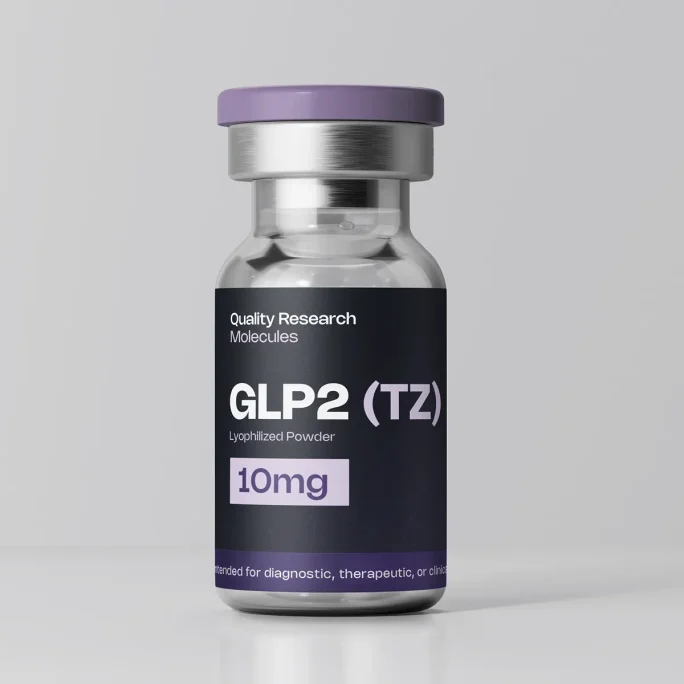
GLP2 (TZ)
Lyophilized Powder
$90.00 – $200.00Price range: $90.00 through $200.00
- Third Party Tested
- ≥99% Purity