
RUO Disclaimer: All QRM products are strictly for in vitro laboratory and research use only by qualified researchers in appropriate facilities. Nothing here implies, suggests, or recommends any diagnostic, therapeutic, or clinical application or use in humans or animals.

- SSL Secured
- Secure Checkout
- Guaranteed Delivery
- Third-Party Tested
KLOW
An advanced research blend combining BPC-157, TB-500, GHK-Cu, and KPV for researchers exploring regenerative, anti-inflammatory, and cellular signaling pathways in a single formulation. Built for comprehensive in vitro research models.
$120.00
- +99% Purity
- Third-Party Tested
- COA Available
- SSL Secured
- Secure Checkout
- Guaranteed Delivery
- Third-Party Tested
An advanced research blend combining BPC-157, TB-500, GHK-Cu, and KPV for researchers exploring regenerative, anti-inflammatory, and cellular signaling pathways in a single formulation. Built for comprehensive in vitro research models.
About KLOW
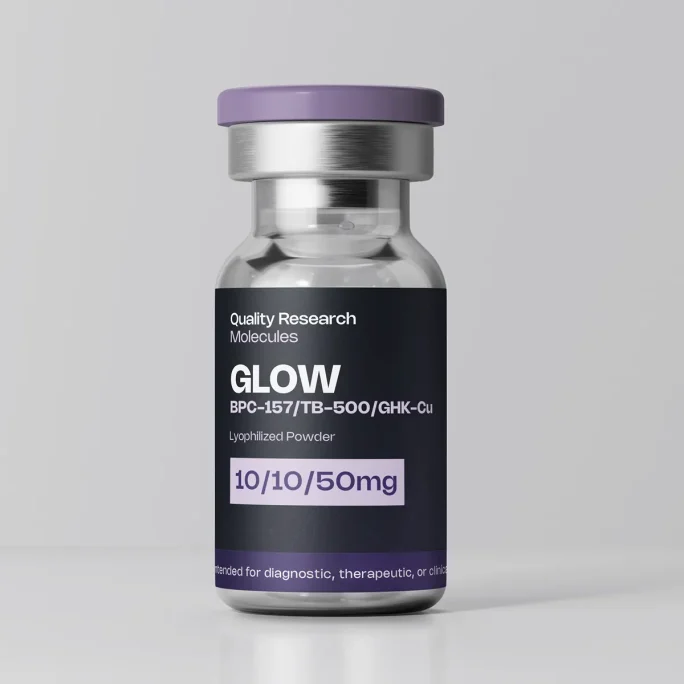
KLOW builds on the established three-component framework of GLOW by introducing KPV, a small tripeptide fragment derived from alpha-MSH, a naturally occurring hormone investigated for its role in inflammatory signaling and pigmentation regulation. While GHK-Cu, BPC-157, and TB-500 work at the level of dermal structure, vascular signaling, and cell migration, KPV operates at a more systemic signaling level, one that researchers have investigated for its role in modulating inflammatory pathway activity and supporting gut barrier function in controlled research settings. This positions KLOW as a more comprehensive research formula for studies examining dermal biology through both direct tissue-level and upstream systemic signaling mechanisms.
The gut-skin axis describes the well-documented relationship between intestinal barrier signaling and dermal pathway activity. When gut barrier integrity is compromised in research models, inflammatory signals have been studied for their potential to enter systemic circulation and contribute to skin signaling patterns characterized by reduced barrier function and accelerated cellular aging markers. KPV has been studied for its potential to support gut lining integrity and reduce inflammatory signal production at the pathway level, making it relevant to investigators examining whether gut-derived inflammatory signaling produces measurable downstream effects on dermal tissue research models.
GHK-Cu, BPC-157, and TB-500 retain their roles as described in the GLOW formula. GHK-Cu has been studied for its effects on collagen synthesis and tissue remodeling signaling. BPC-157 has been researched for its vascular signaling activity, fibroblast pathway support, and upregulation of growth factors relevant to skin and connective tissue repair research. TB-500 has been investigated for its role in cell migration and re-epithelialization, the process by which new skin cells move to cover and restore damaged tissue in laboratory research models. KPV’s addition has been studied for its potential to reduce the inflammatory signaling environment in which these processes occur, with investigators examining whether lower systemic inflammatory pathway activity influences tissue-level repair signaling outcomes in experimental research settings.

Mechanism of Action
- GHK-Cu has been researched for its role in upregulating collagen I, collagen III, and elastin, the structural proteins studied for their contribution to skin firmness and elasticity in dermal tissue research models. It has also been studied for its modulation of enzymes that break down and clear aging or damaged tissue, a process investigated as necessary for organized new tissue formation at the cellular level.
- BPC-157 has been studied for its interaction with the VEGF signaling pathway, a key regulator of blood vessel formation in tissue research models. By promoting endothelial cell activity in vitro, it has been investigated for its potential to influence vascular density, a factor studied for its relevance to nutrient and oxygen delivery in dermal and follicular tissue research contexts.
- TB-500 has been investigated for its regulation of beta-actin, a protein that governs how cells move and reorganize during repair processes in controlled research settings. Studies have examined its effects on the migration of keratinocytes and fibroblasts, two cell types investigated for their roles in wound closure and connective tissue repair signaling in laboratory research models.
- KPV has been studied for its role in reducing pro-inflammatory signal production at the pathway level, with research examining whether suppressing these signals influences skin barrier integrity markers and tissue aging signaling in preclinical research models.
- KPV has also been investigated for its effects on gut lining integrity in vitro. Studies have examined its potential to strengthen the barrier that separates gut contents from systemic circulation, with research theorizing that compromised barrier function allows inflammatory signals to reach dermal tissue research models and contribute to aging and barrier dysfunction signaling at the cellular level.

Research Highlights
KLOW has been studied as a research model for investigating how simultaneous modulation of structural, vascular, and inflammatory signaling pathways influences dermal biology outcomes beyond what single-component peptides achieve in isolation. KPV's addition to the GHK-Cu, BPC-157, and TB-500 framework introduces a systemic anti-inflammatory signaling dimension that researchers have examined as an upstream regulator of the tissue-level repair processes the other three components are studied for.
A distinguishing feature of KLOW as a research formula is its inclusion of KPV as a gut-skin axis modulator alongside structurally and vascularly active peptides. Research has examined whether reducing gut-derived inflammatory signaling through KPV's melanocortin receptor activity creates a more favorable systemic signaling environment for the collagen synthesis, angiogenic, and cell migration pathways that GHK-Cu, BPC-157, and TB-500 are individually investigated for.
KLOW combines GHK-Cu's studied effects on collagen synthesis and extracellular matrix remodeling with BPC-157's VEGF-VEGFR2 pathway activation and TB-500's endothelial cell differentiation activity. Researchers have examined whether this convergence of structural and vascular signaling mechanisms in a single formula produces a more comprehensive dermal tissue repair signaling profile than any individual component is capable of generating in controlled research settings.
All four components of KLOW carry established individual research profiles in tissue repair and inflammatory regulation, and investigators have studied the formula for whether their concurrent activity produces compounding effects at the pathway level. Research has examined whether KPV's reduction of inflammatory signaling at the mucosal and systemic level supports the wound closure, vascular repair, and cell migration pathways that GHK-Cu, BPC-157, and TB-500 are respectively investigated for in combined peptide research models.
Product Specifications
- Molecular Formula
- See individual peptide pages
- Molecular Weight
- See individual peptide pages
- CAS #
- See individual peptide pages
- Sequence
- GHK-Cu, BPC-157, TB-500, KPV (see individual peptide pages)
- Purity
- ≥99% (HPLC verified)
- Form
- Lyophilized powder
- Appearance
- Blue powder
- Solubility
- Universal Solvent
- Storage
- -20°C (lyophilized), 2-8°C (after preparation)
Reference
- Pickart, L., Vasquez-Soltero, J. M., & Margolina, A. (2015). GHK peptide as a natural modulator of multiple cellular pathways in skin regeneration. BioMed Research International, 2015, 648108.
- Kannengiesser, K., Maaser, C., Heidemann, J., et al. (2008). Melanocortin-derived tripeptide KPV has anti-inflammatory potential in murine models of inflammatory bowel disease. Inflammatory Bowel Diseases, 14(3), 324–331.
- Brzoska, T., Luger, T. A., Maaser, C., Abels, C., & Böhm, M. (2008). Alpha-melanocyte-stimulating hormone and related tripeptides: Biochemistry, antiinflammatory and protective effects in vitro and in vivo. Endocrine Reviews, 29(5), 581–602.
- Goldstein, A. L., Hannappel, E., Sosne, G., & Kleinman, H. K. (2012). Thymosin β4: A multi-functional regenerative peptide. Expert Opinion on Biological Therapy, 12(1), 37–51.